

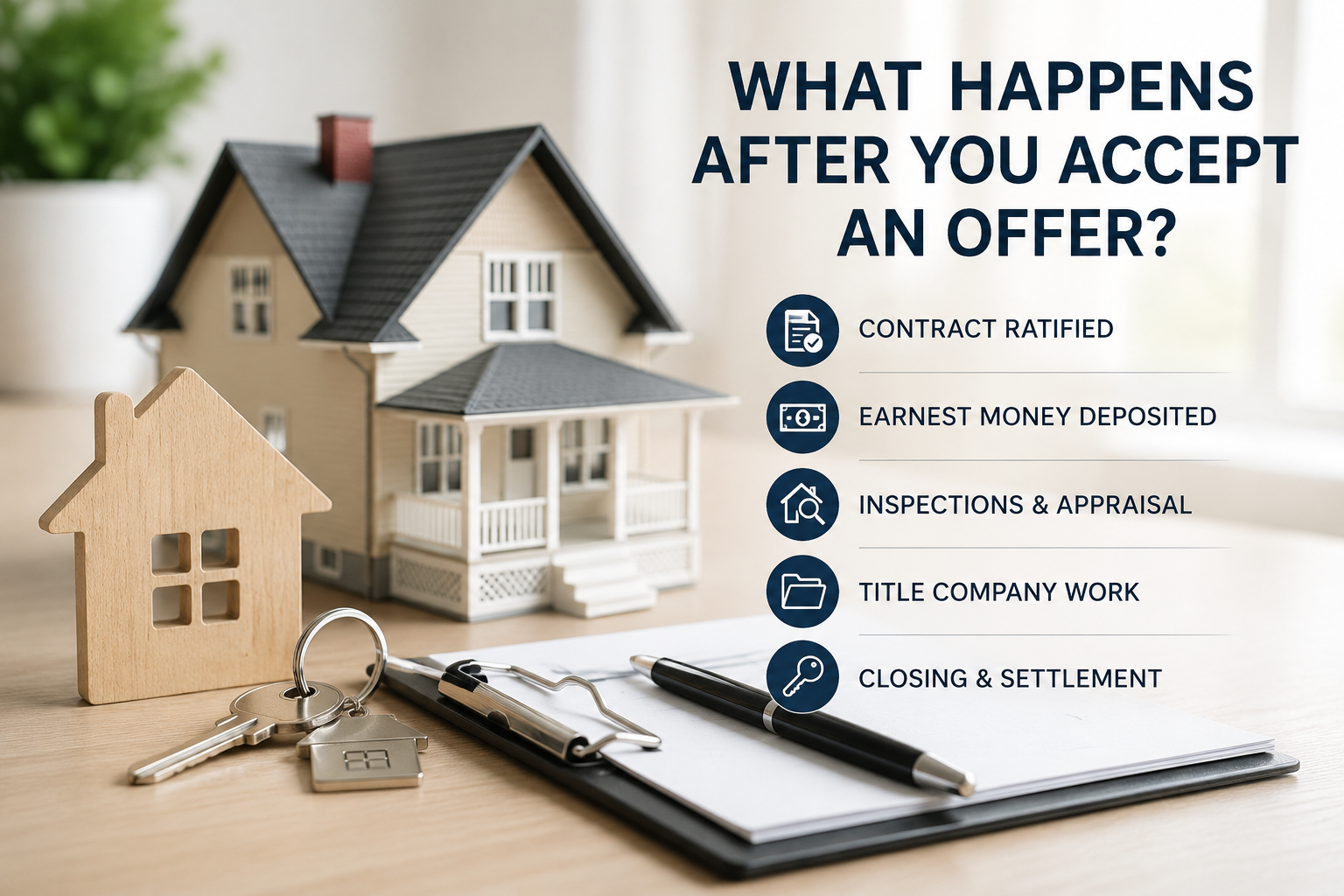
What happens after you accept an offer? Once you accept an offer and both parties sign, the contract is legally “ratified” and a structured timeline kicks in.
Accepting an offer feels like the finish line. It isn’t. It’s the starting gun for a 21-to-45-day sprint that has a lot of moving parts, and where things can go sideways if nobody’s watching the clock.
Here’s what I walk every seller through the moment we get a ratified contract.
Ratification, Earnest Money, and the First Five Days
“Ratified” is the word you’ll hear constantly in Northern Virginia. It simply means both parties have signed the purchase agreement and the contract is now binding. The moment that happens, the clock starts on several deadlines simultaneously.
The most immediate one is earnest money. The funds are typically held by the title company acting as escrow agent, and the buyer must deliver those funds to the title company by the end of the business banking day per the contract timeline.
The deposit is never paid directly to you, the seller. It goes to an escrow agent, sometimes the brokerage’s trust account or, more commonly in Northern Virginia, the title company named in the contract. That title company often serves double duty as both escrow agent and settlement agent, which streamlines the process considerably.
What the contract typically spells out about earnest money: the amount, the deadline for payment, the acceptable forms (certified check, cashier’s check, money order, or wire), and whether the funds must be held in a separate trust account. These are all negotiated terms, not fixed by statute, so your specific contract language controls. A sample Northern Virginia residential purchase agreement shows how this language typically reads in our regional contracts.
One more thing to confirm before ratification: the Virginia Residential Property Disclosures Acknowledgement Form, required under the Virginia Residential Property Disclosure Act (Virginia Code § 55.1-700 et seq.), should be delivered to the buyer before the contract is finalized. In practice, I make sure this is in the buyer’s hands during the offer stage so we’re already compliant the moment you sign. Failing to deliver it on time can give the buyer grounds to terminate or seek damages, not a situation you want to create after you’ve already accepted.
Inspections, Appraisal, and Title Work: The Middle Stretch
This is where most of the action happens, and where a seller’s patience gets tested.
Inspections (typically days 3–14)
The buyer hires and pays for their own inspector. You don’t need to be present (in fact it’s better not to be), but the home needs to be accessible and in its listed condition.
If they request repairs, you’ll negotiate and sign an addendum. Most deals get through this stage, the key is not overreacting to inspection reports. I’ve seen sellers lose solid buyers over a $400 repair request. Context matters.
Appraisal (typically days 10–25)
For financed offers, the buyer’s lender orders an independent appraisal after ratification. The appraiser visits the property and compares it to recent sales to confirm the value supports the loan amount. This usually happens mid-escrow, after inspections wrap up but before the lender issues final underwriting approval.
If the appraisal comes in below contract price and the buyer has an appraisal contingency, you’ll face a choice: reduce the price, negotiate a split, or let the buyer walk. If you priced the home well, and I mean with real comparable data, not wishful thinking, this situation is rare. Here’s more on pricing your Northern Virginia home correctly from the start.
Title work (days 1 through closing)
The title company starts working the moment it receives the ratified contract. Here’s what it’s doing behind the scenes, according to Virginia homebuying and escrow process guidance:
- Title search: The title company searches land records at the relevant circuit court, Fairfax County, Loudoun County, or wherever your property is located, to confirm you have clear, marketable title and to flag any liens, judgments, easements, or ownership gaps.
- Title commitment: They issue a title commitment outlining anything that must be cleared before they’ll insure the title. This might include paying off an old lien you forgot about or correcting a recording error.
- Payoff coordination: They order payoff statements from your mortgage lender and any other lienholders so the exact amounts are ready for settlement day.
The Final Week and Settlement Day
Final walkthrough
The buyer will do a final walkthrough, usually within 24 hours of closing. This is not a second inspection, it’s a verification. Make sure the home is clean, the agreed work is done, and nothing has changed since the contract was signed.
Closing disclosures and logistics
In the days before settlement, the title company sends preliminary settlement statements for everyone to review. You’ll see the payoff of your mortgage, any prorations, and what you’ll walk away with. Confirm the date, time, and location, settlement typically happens at the title company’s office. Bring a government-issued ID, keys, garage remotes, and any HOA documents or access cards the contract requires you to deliver.
Settlement day
You and the buyer may sign together or separately, depending on the arrangement. You’ll sign the deed transferring ownership and a handful of other seller documents.
The whole process, from ratification to keys handed over, runs 21–45 days in most Northern Virginia transactions in 2026. Cash deals can close faster. Financing types like FHA, VA loans, or jumbo products sometimes take a few days longer. Complexity factors, estate sales, multiple liens, rent-back arrangements, or back-up contracts, can extend the timeline further. Every situation is different, and the only way to know what your specific timeline looks like is to work through it with someone who knows this market.
Phase Typical Timing Key Action Ratification Day 0: Contract signed by all parties; timeline begins Earnest money deposited by end of day per contract timeline (business banking days), Inspections Days 7–14: (contract-specific) General, radon, termite; repair negotiations follow, Appraisal Days 10–25 (lender-ordered): Confirms value supports loan amount, Title search and commitment Ongoing from day 1: Title company clears liens, prepares closing package, Final walkthrough 24–48 hours before closing: Buyer verifies condition and completed repairs, Settlement Days 21–45 after ratification: Deed recorded; proceeds disbursed
Frequently Asked Questions
What does “ratified contract” mean in a Northern Virginia home sale?
Ratified means both the seller and buyer have signed the purchase agreement and the contract is legally binding. In Virginia, this is the moment the escrow and settlement timeline officially begins, earnest money deadlines, inspection windows, and the title company’s work all start from the ratification date. It’s the Northern Virginia term for what other markets call “going under contract.”
Who holds the earnest money deposit in Virginia, my agent, the title company, or the buyer?
The earnest money goes to an escrow agent, never directly to you as the seller.
When do inspections and the appraisal happen after I accept an offer?
The appraisal usually follows, ordered by the buyer’s lender mid-escrow, roughly between days 10 and 25. Keeping both on schedule is critical to hitting a 21–45-day closing, which is why I stay on top of these deadlines from day one.
If my buyer backs out, who gets the earnest money under Virginia law?
It depends on why they’re backing out and what the contract says. Under Virginia Code § 54.1-2108.2, the earnest money must stay in escrow until the parties agree in writing on its disposition, a court orders disbursement, or the broker releases it to the party clearly entitled under the contract terms. There’s also a 15-day written-notice process for disputed cases. If a buyer terminates within a valid contingency window, they typically get the deposit back. If they walk without a valid contingency, you may be entitled to it, but the specific contract language controls, and a dispute can take time to resolve.
Is a 21–45-day closing still realistic in Northern Virginia in 2026?
Yes, for most conventional and VA/FHA-financed transactions it is. Cash deals can close faster, sometimes in two weeks. Jumbo loans, complex title situations, estate sales, or contracts with rent-back or home-sale contingencies can push the timeline out. The financing type the buyer brings to the table is usually the biggest variable, which is why I look closely at that when evaluating offers, not just the price.
Accepting an offer is the beginning of the most consequential 21–45 days of your sale. Every deadline matters, every contingency has teeth, and the details in your specific contract are what govern, not general assumptions.
About Cristina Dougherty
Cristina Dougherty is a trusted REALTOR® serving Fairfax and Loudoun Counties, Virginia since 2003. With over 500 homes sold and an average of 30 transactions annually, she specializes in downsizing, first-time buyers, and move-up sellers across neighborhoods like Franklin Glen, Franklin Farm, Armfield Farm, and Chantilly Highlands. Affiliated with Paul Wesley Real Estate, Cristina has earned recognition in Washingtonian Magazine, Northern Virginia Magazine, and RealTrends America’s Best. With over 200 five-star Zillow reviews and an average price point near $800K, she is known for her integrity, local expertise, and client-first approach.
Cristina Dougherty: 703-969-0471, GetKeyedUp@gmail.com
Paul Wesley Real Estate: www.PaulWesley.com
Equal Housing Opportunity. This article is general information only and does not constitute legal, tax, or financial advice. Confirm your specific costs, contract terms, and transaction details with your title company, tax advisor, or lender.